Most Hitter- & Pitcher-Friendly Ballparks 2026 — All 30 MLB Park Factors, Ranked
The most hitter-friendly MLB ballpark in 2026 is Coors Field (park factor 114), followed by Great American Ball Park and Fenway Park (108). The most pitcher-friendly is Oracle Park (92), then T-Mobile Park and Petco Park (94). A park factor of 100 is average.
Not all ballparks are created equal. A home run at Coors Field might be a routine fly ball at Oracle Park. A pitcher with a 3.50 ERA at Petco Park might actually be outperforming a guy with a 3.20 at Great American Ball Park. The difference comes down to park factors— and if you're evaluating players without accounting for where they play, you're missing a big piece of the picture.
Below, we'll break down what park factors are, why they matter, and rank all 30 MLB ballparks from the most hitter-friendly to the most pitcher-friendly for the 2026 season.
What Is a Park Factor?
A park factor (PF) measures how much a ballpark inflates or suppresses run scoring compared to a neutral environment. The baseline is 100. A park factor of 108 means that park produces about 8% more runs than average. A park factor of 94 means about 6% fewer runs.
Park factors are calculated by comparing runs scored in a team's home games to runs scored in their road games, then normalizing across the league. They account for the fact that the same lineups face each other in both halves of a game — it's the park that's the variable, not the teams.
Several things drive park factors: altitude (Coors Field sits at 5,280 feet, where the thin air lets fly balls carry farther and makes breaking pitches break less), outfield dimensions and wall height (Fenway's Green Monster turns fly balls into doubles but also robs home runs), wind patterns (Wrigley with the wind blowing out is a different park than Wrigley with the wind blowing in), temperature and humidity (hot, dry air helps the ball travel), and even the type of grass and foul territory size.
For a deeper look at the terminology, check the park factor entry in our glossary.
Why Park Factors Matter
Park factors are essential for properly evaluating player performance. Consider two first basemen — one plays 81 home games at Coors Field (PF 114), the other plays 81 home games at Oracle Park (PF 92). The Coors hitter could have an identical skill level but put up noticeably better raw numbers simply because of where he plays.
This matters for fantasy baseball, for prospect evaluation, for free agent contracts, and for understanding why certain pitchers suddenly look elite after a trade to San Diego or Seattle. Advanced stats like wOBA, OPS+, and ERA+ all incorporate park factors to level the playing field.
Every game page on Baseball NUT shows a park factor badge so you can instantly see the context behind the numbers. When you're looking at a leaderboard and wondering why a Rockies hitter has inflated counting stats, or why a Mariners pitcher's ERA looks almost too good — now you know where to look.
All 30 MLB Ballparks Ranked by Park Factor (2026)
Here are the park factors we use across Baseball NUT, sourced from multi-year run-scoring data. Parks are ranked from most hitter-friendly to most pitcher-friendly. The color coding tells the story at a glance: red means offense gets a significant boost, blue means pitchers get the edge, and gray is neutral territory.
Is [Your Park] a Hitters Park? Every Stadium, Answered
Each ballpark has its own page with that park's factor, the physical reason behind it, and what it does to a hitter's and a pitcher's line. Pick a stadium:
The Most Hitter-Friendly Ballparks
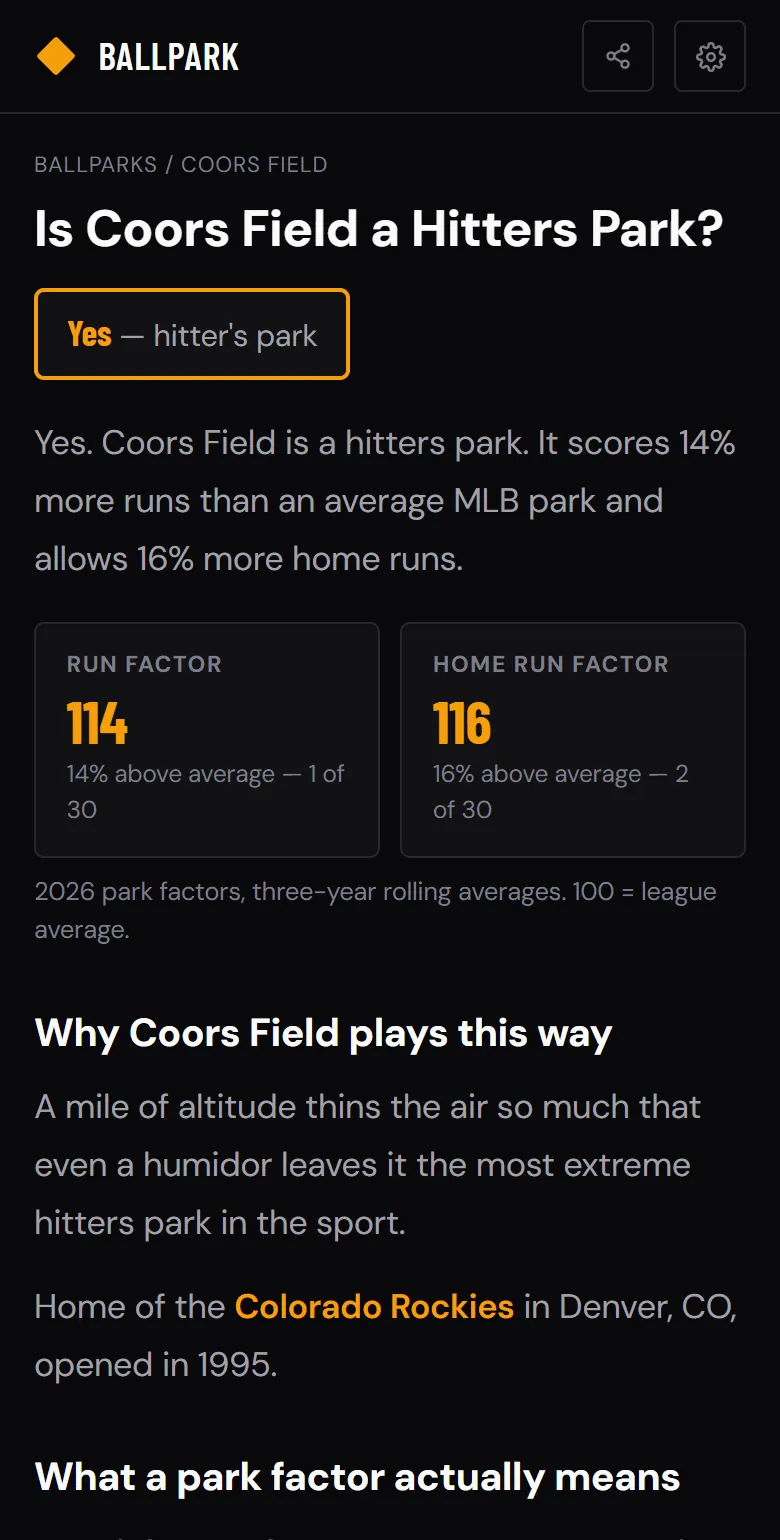
Coors Field (114) stands alone. It's not even close. The mile-high altitude reduces air density by about 15%, which means fly balls carry 5-10% farther and breaking pitches lose a meaningful chunk of their movement. Sliders don't bite. Curveballs hang. Fastballs play flatter. Rockies hitters have feasted at home for decades, but their road splits almost always tell a humbling story. This is why park-adjusted stats exist. Full breakdown of the Coors Field effect →
Great American Ball Park (108) and Fenway Park (108) are tied for second. GABP in Cincinnati has compact dimensions and warm Ohio River air that carries the ball. Fenway is a different animal — the Green Monster at 310 feet down the line turns wall-scraping fly balls into doubles and creates a unique offensive environment that inflates hits more than home runs.
Chase Field (106) in Arizona benefits from warm, dry desert air even with the retractable roof. The four parks tied at 104 — Yankee Stadium, Rate Field, Citizens Bank Park, and Wrigley Field— each boost offense for different reasons. Yankee Stadium's short porch in right field is infamous. Wrigley becomes a launching pad when the wind blows out toward Lake Michigan, though it can also suppress offense when the wind shifts.
The Neutral Parks
The neutral band from 99 to 102 is where parks neither meaningfully help hitters nor pitchers. Target Field (100) is almost perfectly average. Rogers Centre (102) and American Family Field (102) — both parks with retractable roofs — lean very slightly toward hitters. Sutter Health Park (102), the Athletics' temporary home in Sacramento, plays similarly thanks to the warm Central Valley air.
Kauffman Stadium (99) and Truist Park (99) are a hair below average — big enough to notice over 81 home games, but not enough to dramatically reshape a player's stat line. If you're comparing two players with similar numbers and one plays in a 99 park while the other plays in a 104 park, the 99-park player has a genuine edge in true talent.
The Most Pitcher-Friendly Ballparks
Oracle Park (92) is the toughest place to hit in baseball. The cold winds blowing in off McCovey Cove, deep outfield dimensions in right-center, and heavy marine air all conspire against hitters. Giants pitchers have consistently outperformed their road numbers here, and free-agent hitters who sign with San Francisco often see their power numbers crater.
The two parks at 94 — T-Mobile Park and Petco Park— form the next tier of pitcher-friendly environments. T-Mobile Park's marine air layer in Seattle suppresses fly balls, and the retractable roof keeps the park cool. Petco Park's ocean-adjacent location in San Diego creates similar conditions despite the warm climate.
Citi Field (95) has been a known pitcher's park since it opened, with deep alleys and dimensions that punish anything less than a well-struck ball. Dodger Stadium (97) might surprise some fans — it plays slightly pitcher-friendly despite the warm weather, thanks to its deep outfield and the way the evening air settles into Chavez Ravine.
How to Use Park Factors
There are a few practical ways to use this information:
- Fantasy baseball: When evaluating players, look at their home park factor. A .280 hitter at Oracle Park is doing more than a .280 hitter at Coors. Conversely, be wary of Rockies hitters whose road splits collapse.
- Daily lineups: If you play DFS, targeting hitters in games at Coors, GABP, or Fenway gives you a built-in edge. Stack accordingly.
- Pitcher evaluation: A 3.80 ERA at Coors is genuinely impressive. A 3.80 ERA at Oracle Park is good but less noteworthy. Always check where a pitcher throws half his games.
- Trade evaluation: When a player gets traded from a 94-park to a 108-park, expect their numbers to look better — but their underlying skill hasn't changed. Use the Trade Analyzer on Baseball NUT to see projected impact.
On Baseball NUT, the park factor badge appears right on the game page so you always have context. Combined with the NUT Score— which already adjusts for league averages — you get the full picture of who's producing and who's getting a ballpark boost.
A Note on Methodology
Park factors aren't calculated from a single season. A small sample of 81 home games can be influenced by schedule imbalance, roster construction, and weather anomalies. The park factors used on Baseball NUT are based on multi-year run-scoring data to smooth out those fluctuations. They represent the park's true effect on offense, not a one-year blip.
Some analysts break park factors down further — separate factors for home runs, doubles, strikeouts, and walks. Those are useful for deep analysis, but the single-number run-based park factor gives you the most actionable overview. It's the one we display on game pages and use in our stat adjustments across the leaderboard.
Park Factor FAQ
What is the most hitter-friendly MLB ballpark?
Coors Field in Denver, with a park factor of 114 — about 14% more runs than an average park. The altitude (5,280 feet) lets fly balls carry farther and makes breaking pitches break less.
What are the most hitter-friendly ballparks in 2026?
Coors Field (114), Great American Ball Park (108), Fenway Park (108), Chase Field (106), then Yankee Stadium, Rate Field, Citizens Bank Park, and Wrigley Field (all 104).
What is the most pitcher-friendly MLB ballpark?
Oracle Park in San Francisco, with a park factor of 92 — about 8% fewer runs than average. Cold bay winds, deep right-center, and heavy marine air all suppress offense.
What are the most pitcher-friendly ballparks in 2026?
Oracle Park (92), T-Mobile Park (94), Petco Park (94), Citi Field (95), then Busch Stadium, PNC Park, and Tropicana Field (all 96).
What is a park factor in baseball?
A number that measures how much a ballpark raises or lowers run scoring compared to a neutral park. 100 is average; above 100 is hitter-friendly, below 100 is pitcher-friendly.
Why do park factors matter for fantasy baseball?
They show whether a player's stats are inflated or suppressed by his home park. 30 home runs at Oracle Park (92) is a bigger accomplishment than 30 at Coors Field (114).
The Bottom Line
Context matters in baseball. Two identical performances can mean very different things depending on whether they happened at Coors Field or Oracle Park. Park factors give you that context in a single number. Next time you see a Rockies hitter with a .900 OPS or a Giants pitcher with a 2.80 ERA, check the park factor first — then decide how impressed you should be.
Baseball NUT is free, has no ads, no gambling odds, and no clutter. Just live MLB scores, stats, and the context you need to understand what's actually happening on the field.