What Is Total NUT? How We Measure Player Production in Every MLB Game
You check the scores. You see your team won 5-3. But was it actually a good game? Was it a pitcher's duel with one big swing? A back-and-forth slugfest? Or did everyone just kind of... coast?
Total NUT answers that with a single number. It measures the combined player value produced in a game — across both teams, hitters and pitchers. The higher the number, the more standout individual performances happened.
Every finished game on Baseball NUT gets a Total NUT score, color-coded so you can tell at a glance how much elite production was on display.
How Total NUT Is Calculated
Total NUT is the sum of every positive individual NUT contribution from all players in the game. Here's what that means:
- Every hitter's plate appearances are scored using wOBA (weighted on-base average) compared to league average
- Every pitcher's outing is scored using FIP (Fielding Independent Pitching) compared to league average
- Only positive contributions count — a player who went 0-for-4 doesn't drag the game score down
- Both teams contribute — a great game needs great players on both sides
The result: one number that captures how much genuine star-level production the game contained.
The Total NUT Scale
Every Total NUT maps to a tier. The thresholds were calibrated against the entire 2025 MLB season to make sure each tier feels right.
Total NUT in Action
Here's what Total NUT looks like across a range of real games — from the highest-rated games of 2025 to a typical night of baseball from Opening Week 2026.
See how the tiers spread out? Most games on a given night land in the Good range. Great games happen a few times per night, and Nutty games pop up a few times per week — common enough that you'll see them, rare enough that the gold badge still means something.
Total NUT vs the Final Score
A 12-8 game isn't automatically packed with star performances. If most of the runs came from errors, walks, and bloopers, the Total NUT will be modest. Conversely, a 2-1 game can score surprisingly high if the winning run came off a 3-HR night and the losing pitcher threw 8 innings of 1-run ball with 11 strikeouts.
Total NUT doesn't measure drama, walkoffs, or narrative. It measures how much genuine player value was produced. That's what separates it from a simple box score.
Where to See Total NUT
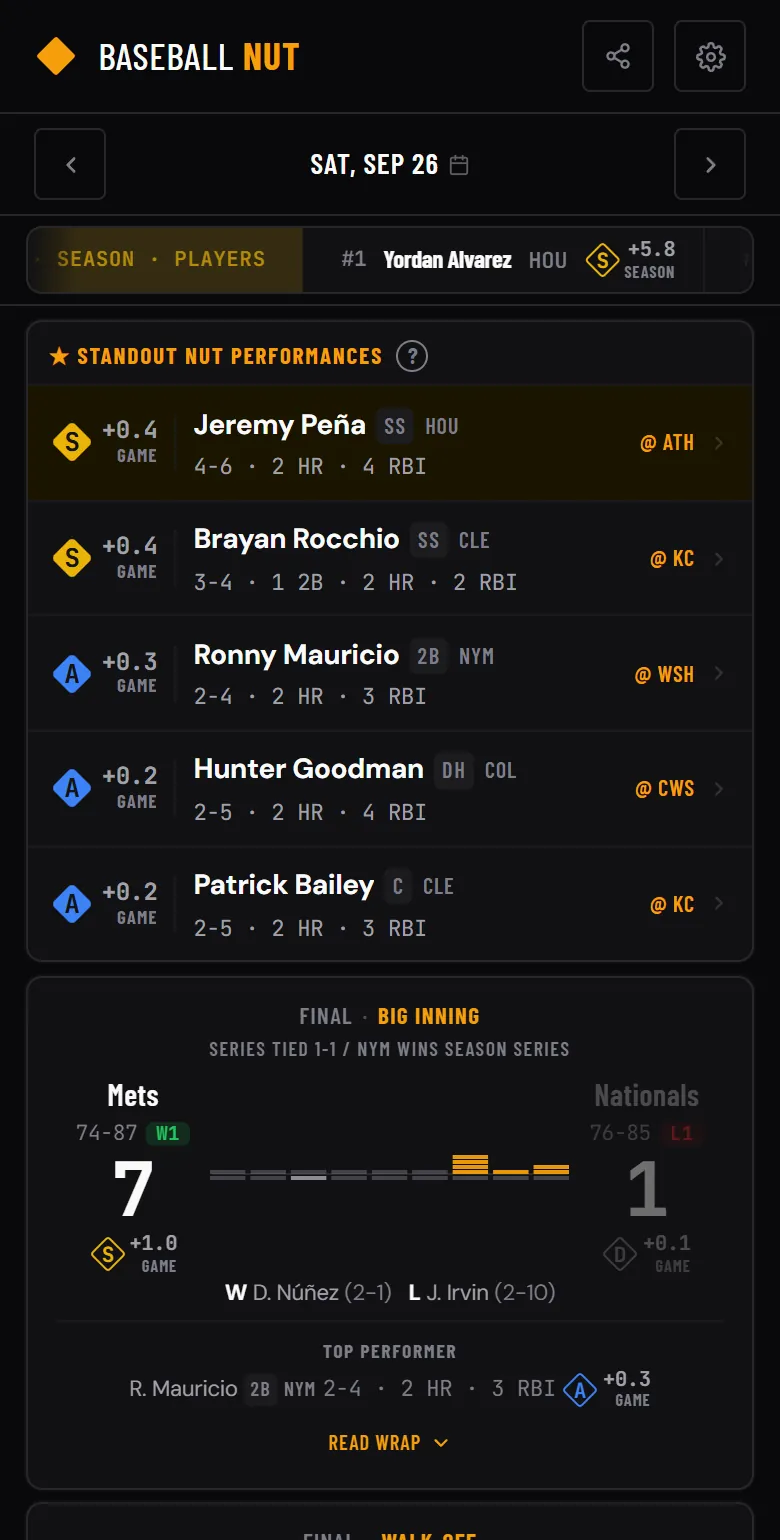
On Baseball NUT, every finished game splits its Total NUT by team, so you can see how each side contributed:
- Scoreboard — each team's NUT shows directly under its score, tier-colored. Add the two numbers to get the game's Total NUT.
- Game detail page — each team's NUT sits right below its name in the matchup header, with the same tier color.
Splitting by team makes it obvious when one side carried the game — a lights-out pitcher against a lineup that couldn't catch up, for example. A team can lose 3-0 and still post a respectable NUT if its starter went seven innings with ten strikeouts. The color tells you the tier; the split tells you who did the work.
Common Questions
Can a game's Total NUT be negative?
No. Total NUT only sums positive player contributions, so the floor is 0. A game with no standout performances would score near 0, not below it.
Does a higher-scoring game always have more Total NUT?
Not necessarily. Total NUT rewards efficient production — home runs, high wOBA, dominant pitching — not just volume. A sloppy 13-10 game can score lower than a clean 4-2 game with a great starter and a three-homer hitter.
Do relief pitchers contribute to a game's Total NUT?
Yes. Every pitcher who throws at least one inning gets scored. A lights-out closer who strikes out the side in the ninth adds to the total just like the starter.
How rare is a Nutty game?
Uncommon but not impossible. In the 2025 season (~2,430 games), around 30-40 reached the Nutty threshold of 1.2+ NUT — roughly a few per week. Common enough that you'll see them, rare enough that they still feel special.
Start Watching Smarter
Next time you check the scores, look for the color. Gold means history. Purple means you should find the highlights. Everything else? You probably didn't miss much.