How to Use NUT Score for Fantasy Baseball in 2026
Fantasy baseball managers obsess over the right stats. Batting average, OPS, ERA, WHIP — they all tell part of the story. But none of them answer the question that actually matters: how much is this player actually producing?
That's what NUT Score does. It converts a player's hitting or pitching production into a single number above or below league average, using the same inputs that drive real outcomes: plate discipline, power, strikeouts, and walk rates. No fielding estimates, no black-box adjustments. Just production you can see in the box score, translated into a single number.
If you play fantasy baseball, NUT is the edge your leaguemates don't have yet. Here's how to use it.
What NUT Tells You That Other Stats Don't
Most fantasy managers evaluate hitters with AVG, HR, RBI, and OPS. Those are fine for surface-level reads, but they don't weight outcomes properly. A walk and a single aren't equally valuable. A double is worth more than either. NUT uses wOBA (weighted on-base average) under the hood, which assigns the correct run value to every plate appearance outcome, then converts that into a single production number.
For pitchers, NUT uses FIP (fielding independent pitching) instead of ERA. ERA punishes pitchers for bad defense behind them and rewards pitchers on good defensive teams. FIP strips that out and focuses on what the pitcher actually controls: strikeouts, walks, hit batters, and home runs. That's a better predictor of future performance — which is exactly what you want for fantasy.
The result: NUT shows you who is actually producing value, not who is over- or underperforming their contact quality.
Evaluating Trades with the Trade Analyzer
Someone in your league offers you a deal. Your gut says it's close. How do you know for sure?
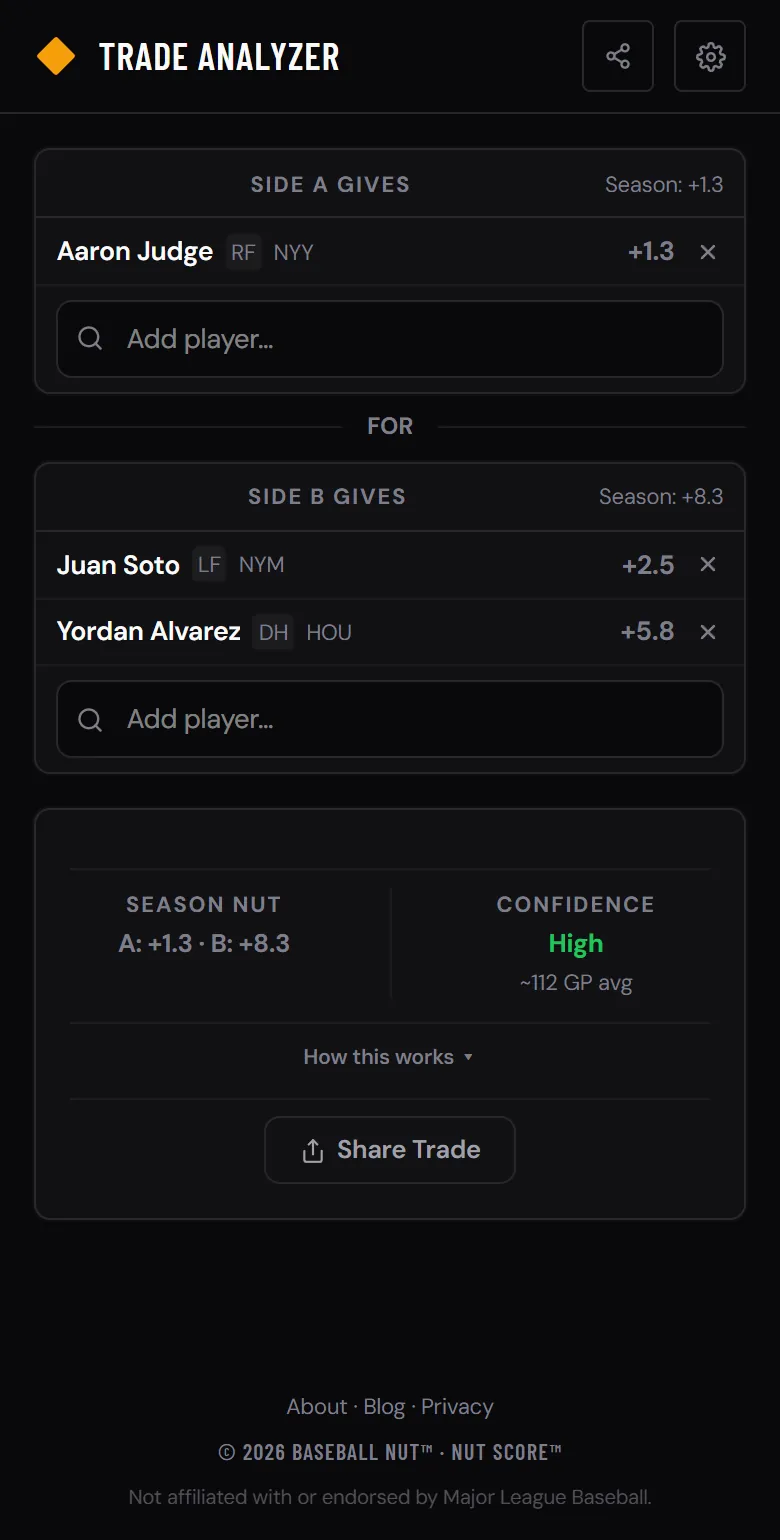
The Trade Analyzer lets you drop players on each side and see the projected rest-of-season NUT for both. It blends last season's full production with the current pace, weighting more toward actual 2026 data as the sample grows. Early in the season, it leans on last year. By June, it's mostly using what's happening now.
The key insight: NUT projections use total season value, not per-game rates. A player who put up +3.0 NUT in 80 games last year projects as a +3.0 player, not a +6.0 player. Durability matters. A guy who plays 150 games is more valuable in fantasy than one who plays 80 — and the Trade Analyzer reflects that.
Finding Waiver Wire Gems
The Hot & Cold page shows who's producing the most NUT value right now. This is where you find the waiver wire pickups before your leaguemates do.
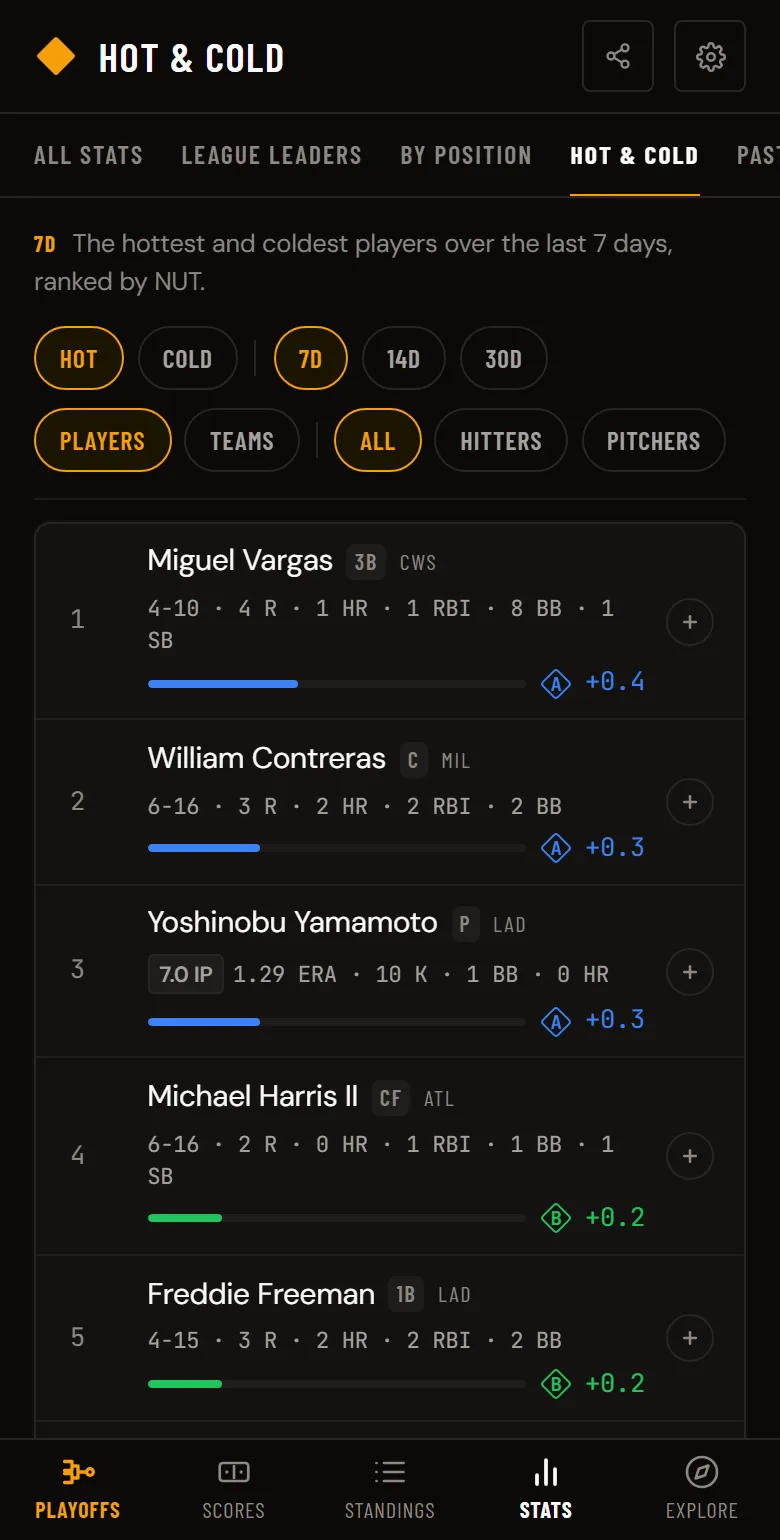
A player trending up in NUT means their underlying production — walk rate, power, strikeout rate — is genuinely improving, not just that a few soft-contact hits found grass. And because NUT updates after every game, you can spot breakouts in real time instead of waiting for end-of-week recaps.
Pair this with the quick stats filters on any player's profile page — toggle between All, Last 7D, and Last 14D to see their recent slash line alongside the NUT it produced. If a player is hitting .350 over the last week but their NUT is barely positive, the production might be shallow — singles and soft contact, not real impact. If someone is hitting .250 but their NUT is strong, they're walking, hitting for power, and contributing more than the average looks.
Roster Decisions: Start, Sit, Drop
The Player Tracker lets you build a watchlist of players and see their current-season NUT at a glance. Add your fantasy roster, add a few waiver targets, and you have a dashboard that shows real value instead of box score noise.
Here's a simple framework for using NUT in weekly roster decisions:
Pitchers: Why FIP Matters More Than ERA for Fantasy
If you've ever had a pitcher post a 2.50 ERA in the first half and then blow up to a 4.80 in the second, you've seen ERA regression in action. ERA includes outcomes the pitcher doesn't control — defensive plays, sequencing variance, BABIP fluctuations. FIP strips those out.
NUT uses FIP because it's a better predictor of where a pitcher is headed. A pitcher with a 4.00 ERA but a 3.00 FIP is probably about to get a lot better. A pitcher with a 2.80 ERA but a 4.20 FIP is a sell-high candidate before the regression hits.
Check any pitcher's NUT on their profile page and compare it to their ERA. When NUT and ERA disagree, trust NUT — it's telling you what the box score hasn't caught up to yet.
The Bottom Line
Fantasy baseball is a game of information edges. Most of your leaguemates are looking at the same ESPN blurbs and batting averages. NUT gives you a cleaner signal: real production, updated daily.
Use the Trade Analyzer to evaluate deals. Use Hot & Cold to find pickups early. Use the Player Tracker to monitor your roster. And when you're deciding between two players, look at the NUT — the player producing more is the one you want.
It's free, it updates every game, and it works on your phone. That's it. Go win your league.