Most Home Run Friendly Ballparks 2026 — All 30 MLB Parks by HR Factor
Every ballpark changes the numbers. A fly ball that dies on the warning track in San Francisco lands ten rows deep in the Bronx, and the hitter’s stat line does not tell you which one happened. Park factors fix that: 100 is neutral, above 100 favors hitters, below 100 favors pitchers. A run factor of 108 means that park produces about 8% more runs than an average one.
Below is a direct answer for all 30 stadiums, using 2026 park factors for both runs and home runs — because those two do not always agree, and the parks where they split are the ones people get wrong. Pair them with NUT Score when you judge a hitter: NUT measures production against league average, so the park is context you apply yourself.
The short answer
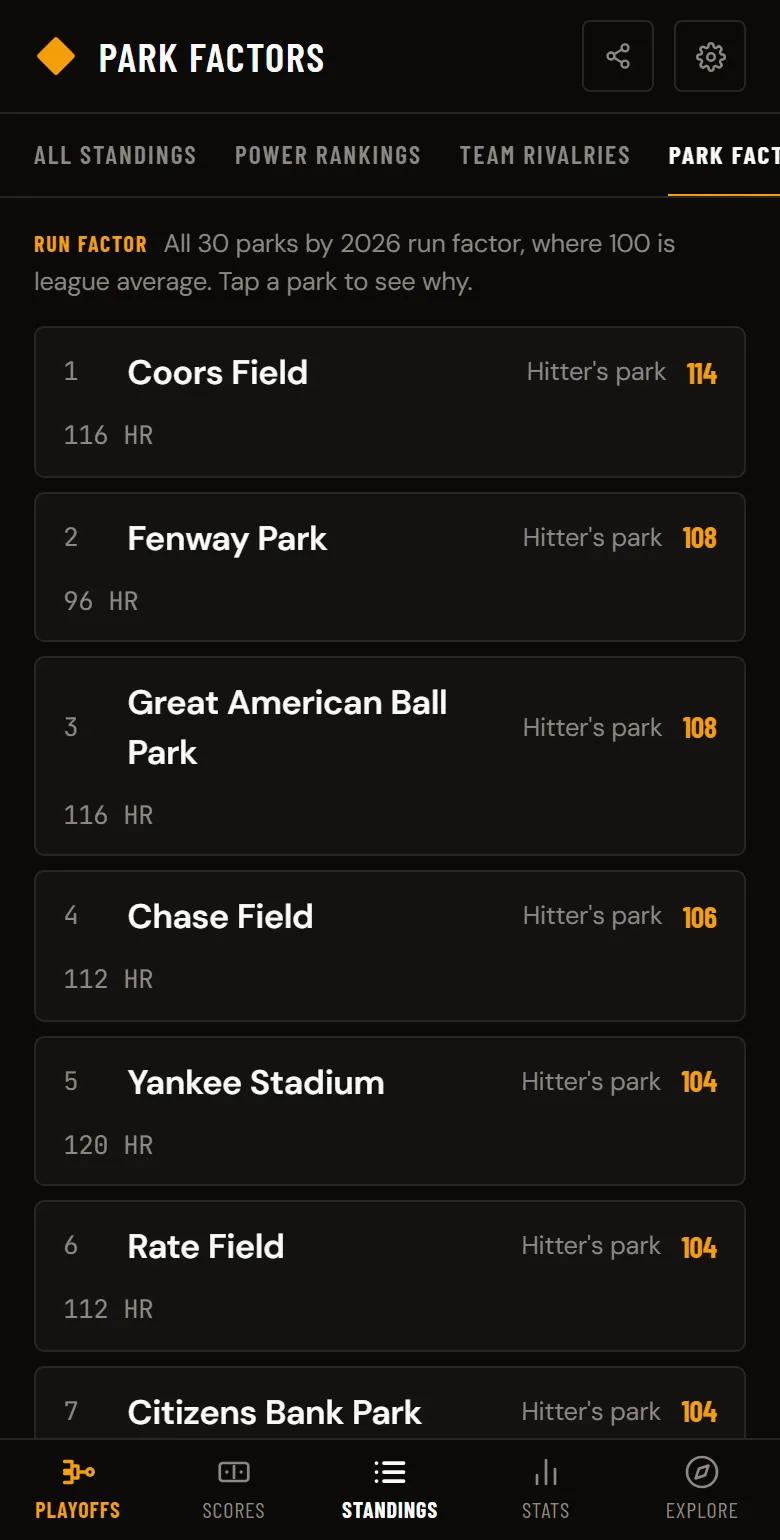
8 hitters parks: Coors Field, Fenway Park, Great American Ball Park, Chase Field, Yankee Stadium, Rate Field, Wrigley Field, Citizens Bank Park.
7 pitchers parks: Oracle Park, Petco Park, T-Mobile Park, Citi Field, PNC Park, Busch Stadium, Tropicana Field.
The other 15 are effectively neutral, though several lean far enough in one direction to matter over a full season.
Hitters parks
Run factor of 104 or higher. Ordered most to least extreme.
Is Coors Field a hitters park?
Yes — the most extreme hitters park in baseball. Mile-high air carries the ball, and the enormous outfield the Rockies built to compensate turns would-be outs into doubles and triples.
Run factor 114 · HR factor 116 · Colorado Rockies
Is Fenway Park a hitters park?
Yes for runs — but no for home runs. This is the most misunderstood park in MLB. The Green Monster manufactures doubles off balls that would be outs elsewhere, but it is also 37 feet tall, so it turns home runs into singles. The HR factor of 96 is below league average.
Run factor 108 · HR factor 96 · Boston Red Sox
Is Great American Ball Park a hitters park?
Yes, strongly. Short porches in both corners make it the second-best home run park in baseball behind Yankee Stadium.
Run factor 108 · HR factor 116 · Cincinnati Reds
Is Chase Field a hitters park?
Yes. Even with the roof closed, dry desert air and deep gaps produce runs. It is the second-most hitter-friendly park in the National League.
Run factor 106 · HR factor 112 · Arizona Diamondbacks
Is Yankee Stadium a hitters park?
Yes — and the best home run park in MLB. The 314-foot right field porch gives left-handed pull hitters a target no other park offers. A 120 HR factor is the highest in baseball.
Run factor 104 · HR factor 120 · New York Yankees
Is Rate Field a hitters park?
Yes. Symmetrical but shallow, with a wind pattern that pushes balls out to left. Formerly Guaranteed Rate Field.
Run factor 104 · HR factor 112 · Chicago White Sox
Is Wrigley Field a hitters park?
Yes on average — but it depends on the wind. No park in baseball swings this far day to day. Wind blowing out toward Waveland makes it a launching pad; wind blowing in makes it one of the toughest parks in the league. The 104 is the average of both.
Run factor 104 · HR factor 108 · Chicago Cubs
Is Citizens Bank Park a hitters park?
Yes. Compact dimensions all the way around make it one of the best power parks in the National League.
Run factor 104 · HR factor 112 · Philadelphia Phillies
Neutral parks
Run factor between 97 and 103 — close enough to average that the park is not the reason for a hot or cold stretch.
Is Daikin Park a hitters park?
Slightly — it leans hitter. The Crawford Boxes in left are one of the shortest home run targets in baseball. Formerly Minute Maid Park.
Run factor 103 · HR factor 108 · Houston Astros
Is Rogers Centre a hitters park?
Mildly. The renovated outfield brought the fences in, and it now plays as a modest home run park under the dome.
Run factor 102 · HR factor 108 · Toronto Blue Jays
Is American Family Field a hitters park?
Mildly. Roof closed, it plays as a solid power park; roof open, it is closer to neutral.
Run factor 102 · HR factor 108 · Milwaukee Brewers
Is Sutter Health Park a hitters park?
Slightly, for runs only. The Athletics’ Sacramento home plays warmer and smaller than the Coliseum ever did, but home runs land near league average.
Run factor 102 · HR factor 100 · Athletics
Is Oriole Park at Camden Yards a hitters park?
Roughly neutral for runs, above average for homers. The left field wall was pushed back in 2022 and pulled partly back in, so right-handed power is suppressed while left-handed power still plays.
Run factor 101 · HR factor 108 · Baltimore Orioles
Is Nationals Park a hitters park?
Barely — it is close to neutral. A slight tilt toward hitters, mostly in the home run column.
Run factor 101 · HR factor 104 · Washington Nationals
Is Target Field a hitters park?
No — it is dead neutral for runs. A run factor of exactly 100 makes it the most balanced park in baseball. Home runs play slightly up, everything else plays even.
Run factor 100 · HR factor 104 · Minnesota Twins
Is Truist Park a hitters park?
No — it is neutral. Despite a reputation for offense, the park itself does almost nothing to the numbers in either direction.
Run factor 99 · HR factor 100 · Atlanta Braves
Is Kauffman Stadium a hitters park?
No — slightly pitcher-leaning. Enormous outfield gaps produce triples but suppress home runs.
Run factor 99 · HR factor 96 · Kansas City Royals
Is Progressive Field a hitters park?
No — it leans pitcher. Cool lake air and a deep left-center gap hold down power.
Run factor 98 · HR factor 96 · Cleveland Guardians
Is loanDepot park a hitters park?
No — it leans pitcher. The fences came in for 2020, which softened what was once one of the most extreme pitchers parks in baseball, but it still plays under average.
Run factor 98 · HR factor 96 · Miami Marlins
Is Comerica Park a hitters park?
No — it is a pitchers park, especially for power. Deep center field and cold spring weather make it one of the tougher home run parks in the American League.
Run factor 97 · HR factor 92 · Detroit Tigers
Is Globe Life Field a hitters park?
No — it leans pitcher. A surprise to most people. The air conditioning under the roof keeps the ball from carrying the way it did at the old open-air park.
Run factor 97 · HR factor 96 · Texas Rangers
Is Angel Stadium a hitters park?
No — it leans pitcher. Marine layer air in Anaheim knocks down fly balls, particularly at night.
Run factor 97 · HR factor 96 · Los Angeles Angels
Is Dodger Stadium a hitters park?
No for runs — though it plays bigger than its home run reputation. Dodger Stadium gives up plenty of homers in raw counts because the Dodgers hit a lot of them, but the park itself suppresses scoring.
Run factor 97 · HR factor 96 · Los Angeles Dodgers
Pitchers parks
Run factor of 96 or lower. Ordered least to most extreme.
Is Tropicana Field a hitters park?
No — it is a pitchers park. Dead indoor air and deep power alleys hold down both runs and home runs.
Run factor 96 · HR factor 94 · Tampa Bay Rays
Is Busch Stadium a hitters park?
No — it is a pitchers park. Heavy summer air in St. Louis and a deep outfield make this one of the harder places in the NL to hit the ball out.
Run factor 96 · HR factor 92 · St. Louis Cardinals
Is PNC Park a hitters park?
No — and it is one of the worst home run parks in baseball. The 21-foot Clemente Wall in right and a cavernous left-center gap combine for an 88 HR factor.
Run factor 96 · HR factor 88 · Pittsburgh Pirates
Is Citi Field a hitters park?
No — it is a pitchers park. Even after multiple rounds of moving the fences in, Citi Field still suppresses run scoring.
Run factor 95 · HR factor 96 · New York Mets
Is T-Mobile Park a hitters park?
No — it is one of the best pitchers parks in the AL. Cool, damp Seattle air is about as unfriendly to a fly ball as conditions get.
Run factor 94 · HR factor 92 · Seattle Mariners
Is Petco Park a hitters park?
No — strongly pitcher-friendly. Marine air and a deep right-center field make it one of the two hardest parks in baseball to homer in.
Run factor 94 · HR factor 88 · San Diego Padres
Is Oracle Park a hitters park?
No — it is the most pitcher-friendly park in MLB. Cold bay air, a 24-foot right field wall, and the 415-foot chasm known as Triples Alley give it an 84 home run factor, the lowest in baseball by a wide margin.
Run factor 92 · HR factor 84 · San Francisco Giants
All 30 ballparks ranked by home run factor
The lists above rank by run factor. Home runs are a separate question, and the order changes a lot — 100 is league average, so 120 means 20 percent more home runs than a neutral park would allow.
Read the two numbers together. A park can sit near the top for home runs and in the middle for runs, which is a different kind of hitters park than one that piles up doubles.
When runs and home runs disagree
Three parks are worth knowing specifically, because the single-number answer misleads:
Fenway Park (108 runs, 96 home runs). The best hitters park in the American League and a below-averagehome run park at the same time. The Green Monster is 37 feet tall and 310 feet away — it converts outs into doubles and home runs into singles. A slugger who pulls fly balls to left gets less out of Fenway than the reputation suggests; a line-drive hitter gets far more.
Yankee Stadium (104 runs, 120 home runs). Only modestly above average for scoring, but the best home run park in baseball by a clear margin, and almost entirely for left-handed pull hitters. See the short porch explained.
Kauffman Stadium (99 runs, 96 home runs). Neutral for scoring because the huge outfield gaps generate doubles and triples, while the same distance suppresses home runs.
How to use this
Park factors are a correction, not a verdict. A hitter with a .900 OPS at Coors Field and a hitter with a .900 OPS at Oracle Park did not have the same season — and the gap is roughly 20 percentage points of OPS, which is the difference between an average regular and an All-Star.
Baseball NUT does not fold this into its numbers for you: NUT measures production against league average and adjusts for the season’s run environment, but it carries no park factor. Read the two together — the NUT leaderboard for the production, the table above for the discount that production deserves. Tapping any game on the scoreboard shows that venue’s factor alongside the box score.
For the full ranked table and a deeper explanation of how park factors are calculated, see hitter-friendly ballparks 2026.
Park factors are three-year rolling averages, updated each spring. Values above are for the 2026 season.