The Yankee Stadium Short Porch — Baseball’s Best Home Run Park
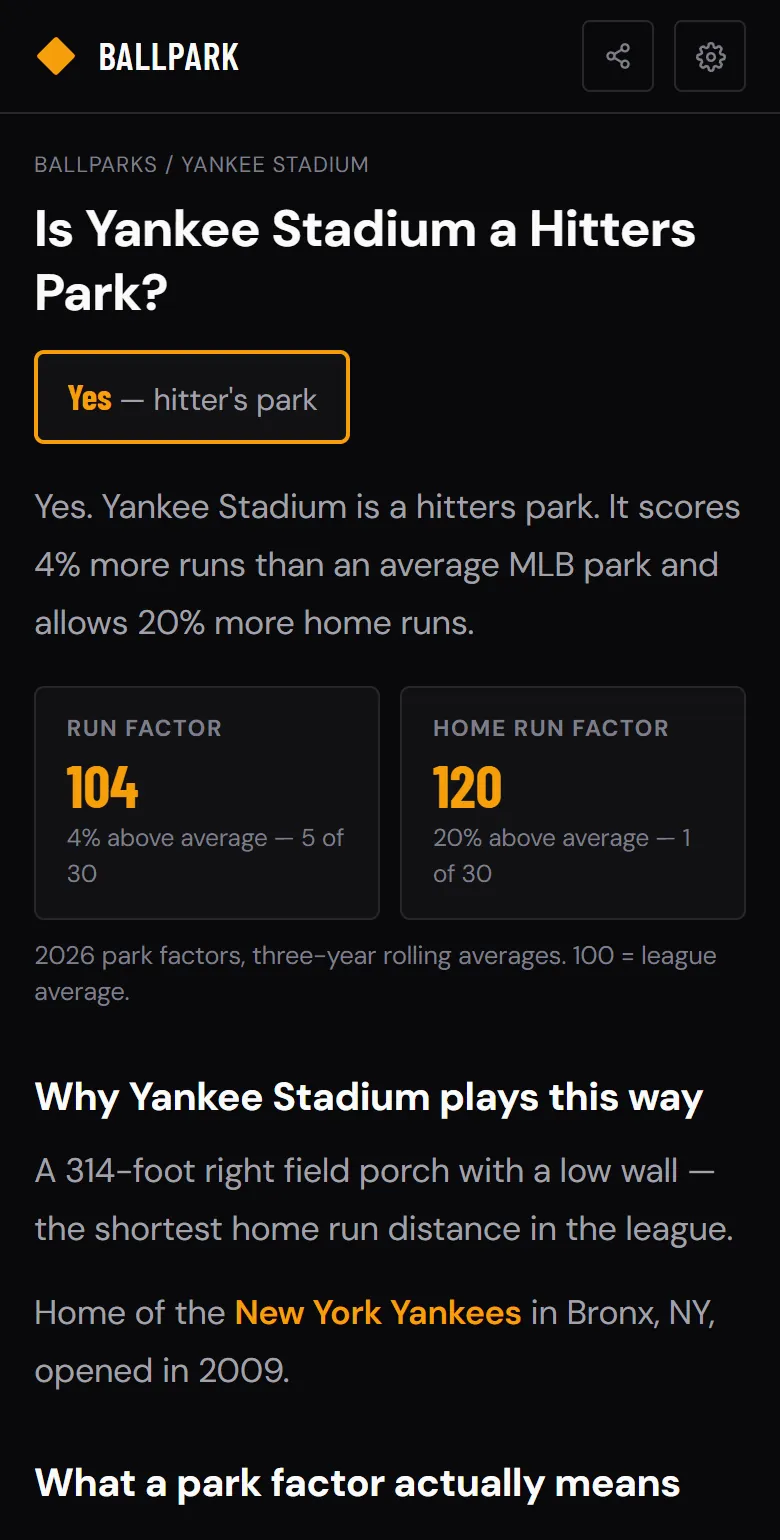
Yankee Stadium has a home run park factor of 120. That is the highest of any stadium in Major League Baseball — higher than Coors Field, which sits at 116 with a mile of thin air working for it. No park in the sport turns fly balls into home runs at a greater rate.
Its run factor is only 104.
That gap is the whole story. A park factor of 100 is neutral and the distance from 100 is roughly the percentage effect, so Yankee Stadium inflates home runs by about 20% while inflating scoring by about 4%. It is not a hitter's park in the way Coors or Fenway are. It is a home run park, and almost nothing else.
What the Porch Actually Is
The right field foul pole sits about 314 feet from home plate, and the wall stays shallow as it bends toward right-center before the field opens up. That corner is the short porch. A ball hit at a modest angle to right — the kind that dies on the warning track in most parks — clears the fence in the Bronx.
Two things follow from a wall being close in only one direction. First, the effect is concentrated in home runs rather than spread across all offense, because the porch converts fly outs into homers without creating extra singles or doubles. Second, and less obvious to most fans, it does not help everyone equally. Pull-hitting left-handed batters aim at that corner. Right-handed batters mostly do not.
The 2026 Splits
Here is every Yankees hitter with 10 or more home runs this season, sorted by how much more often he homers at home. Figures are home runs per 100 at-bats, at home and away.
H = home runs per 100 AB at Yankee Stadium, A = same on the road. 2026 season through August 23.
As a group these hitters homer 5.79 times per 100 at-bats at home and 4.34 on the road— about a third more often in the Bronx. That is a bigger gap than the 120 park factor alone implies, which is what you would expect from a roster built to take advantage of the porch rather than a random sample of hitters passing through it.
The Handedness Test
Split the same eight hitters by which side of the plate they stand on and the porch stops being a theory:
The lefties get a large boost. The righties get nothing, or a little less than nothing. Trent Grisham is the extreme case — 6.82 per 100 at home against 2.88 on the road, more than double — and Cody Bellinger is close behind at 4.62 against 1.46.
It is not unanimous, and it should not be presented as though it were. Luis García Jr. is left-handed and homers slightly more on the road; Amed Rosario is right-handed and homers more at home. Half a season of splits is a small sample, and schedule strength, pitcher handedness, and plain luck all leave fingerprints on numbers this size. The pattern is strong and it points the right way. It is not a law.
What to Do With This
When a left-handed Yankee hits 30 home runs, some of those homers belong to the building. That is not an accusation — every hitter in baseball plays half his games somewhere, and the somewhere always matters. It is a reason to check the environment before reading a raw total as a measure of the player.
The same logic runs in reverse across town and across the country. A left-handed hitter in San Francisco plays in an 84 home run factor, the lowest in MLB, and loses homers the Bronx would have granted him. The full park factor rankings cover all 30 stadiums, and the Coors Field deep dive handles the one park that distorts even more than this one, for entirely different reasons.
The NUT Score measures production in runs above average rather than in raw counting totals, which is how the app compares a Yankees left-hander to a Giants left-hander without the ballpark casting the deciding vote. Every team page and game page on Baseball NUT labels the venue's run environment, so you see the context alongside the box score instead of having to remember it.
Park factors are the environment. To see who is producing inside it, the full board is at baseballnut.app/stats, updated daily.