How to Read Percentile Rankings in Baseball (Like Baseball Savant)
You've probably seen those colorful horizontal bars on Baseball Savant or on a player's profile here on Baseball NUT. They look great, but if nobody ever explained what they mean, they can feel like a wall of numbers. Good news: they're actually one of the simplest and most useful ways to evaluate a player once you know what you're looking at.
This guide breaks down everything you need to know about percentile rankings in baseball — what they measure, how to read the colors, and how to use them to quickly size up any hitter or pitcher in the league.
What Is a Percentile Ranking?
A percentile ranking tells you how a player compares to every other player in that stat. Think of it like lining up all 700+ MLB players from worst to best in a single category. A player's percentile tells you where they stand in that line.
50th percentile = dead average. Half the league is better, half is worse. 90th percentile = top 10% of the league. 10th percentile = bottom 10%. A player at the 99th percentile is essentially the best in baseball at that stat. A player at the 1st percentile is the worst.
The beauty of percentiles is that you don't need to know what a "good" number is for each stat. You don't need to memorize that a .320 OBP is below average or that a 9.5 K/9 is great. The percentile does that work for you. If the bar says 85th percentile, you know the player is well above average — regardless of the stat.
The Color Scale
On Baseball NUT, every percentile bar is color-coded so you can read a player's profile at a glance without squinting at numbers. The colors match the tier system used throughout the app, including the NUT Score tiers:
Gold bars jump off the screen. Red bars are warning signs. Green means above average, gray means average. When you pull up a player and see mostly gold and green, you're looking at a good player. When you see a mix of gold and red, you're looking at someone with extreme strengths and weaknesses — and that's where it gets interesting.
Hitter Percentile Stats
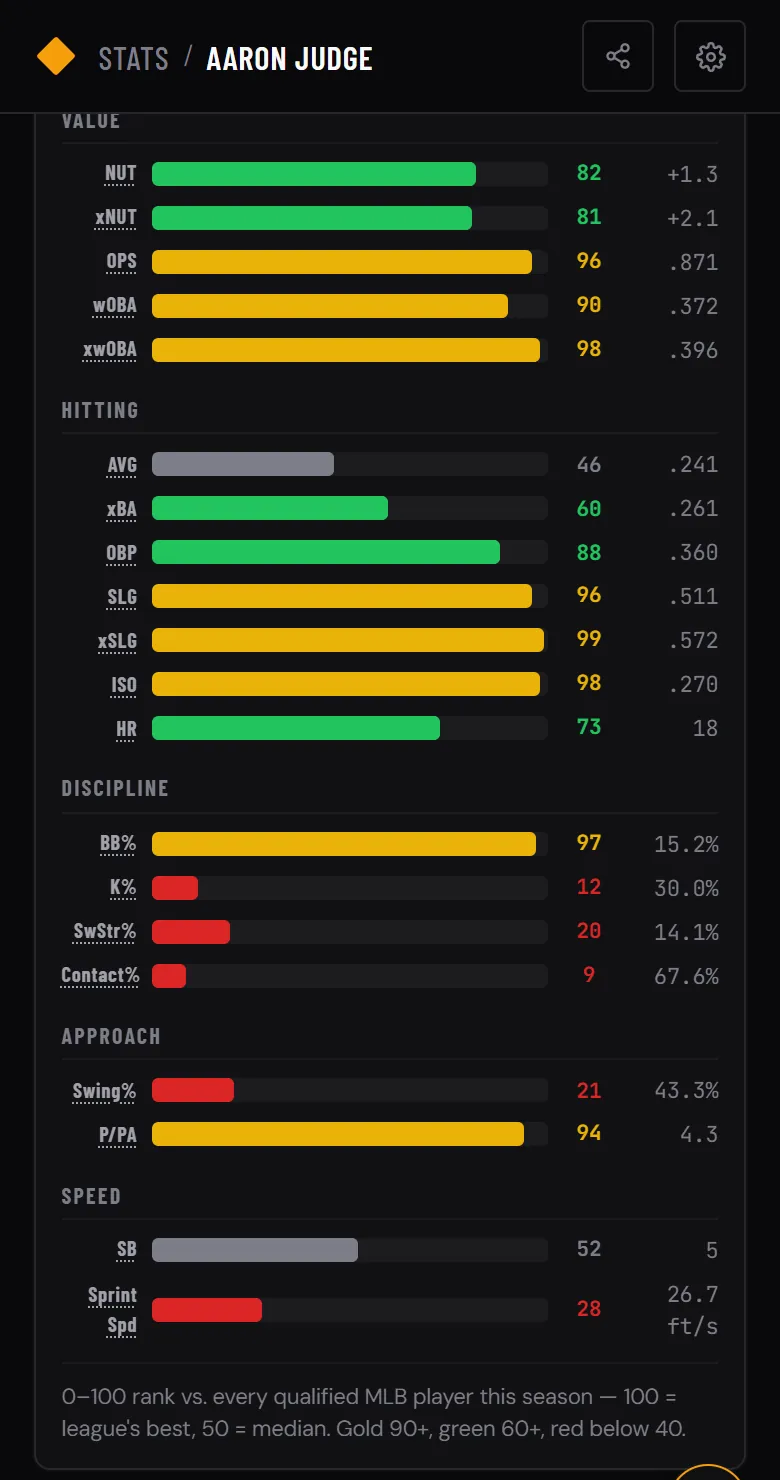
On every hitter's Season tab in Baseball NUT, percentile bars are grouped into five sections so you can read them in layers — overall value first, then hitting production, then plate discipline (the directional plate-skill metrics), then approach (stylistic, neither direction inherently better), then speed.
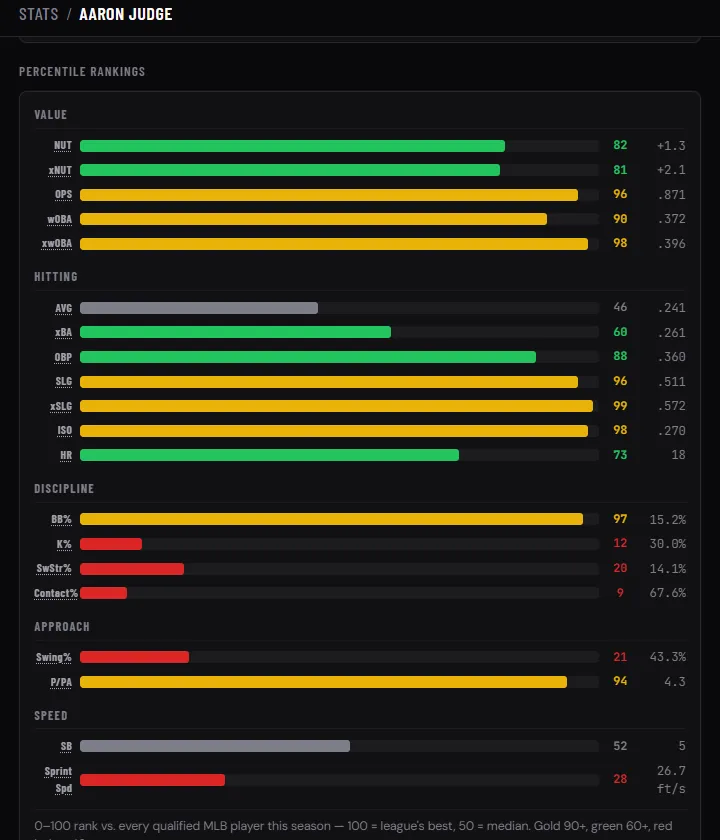
One thing worth flagging upfront: each actual stat sits next to its expected counterpart where one exists — AVG next to xBA, SLG next to xSLG, wOBA next to xwOBA, NUT next to xNUT. The contrast is the point. If the actual bar is gold but the expected bar is gray, you're looking at a hitter due for regression. If they match, the production is real.
One more note on the Approach section: Swing% and P/PA don't have a clear "good" direction the way the Discipline metrics do. Patient hitters and aggressive hitters can both produce elite seasons. The bars in Approach show magnitude — where the hitter sits in raw frequency — not a verdict on whether their style is better or worse than the league.
| Stat | What It Tells You |
|---|---|
Value NUT | Overall production above or below league average. The single best summary of a hitter's production. |
| xNUT | Expected NUT, derived from xwOBA and PA. The luck-adjusted version of NUT for hitters. |
| wOBA | Weighted on-base average. The best single-number rate stat for hitter value. |
| xwOBA | Expected wOBA, based on quality of contact. The luck-adjusted version of wOBA. |
Hitting AVG | Batting average. How often they get a hit per at-bat. |
| xBA | Expected batting average, based on launch angle and exit velocity. Reveals whether AVG is real or lucky. |
| SLG | Slugging percentage. Total bases per at-bat. Measures raw power output. |
| xSLG | Expected slugging. The contact-quality version of SLG. |
| OBP | On-base percentage. How often they reach base, including walks and HBP. |
| ISO | Isolated power (SLG minus AVG). Pure power output, stripping out singles. |
| HR | Home runs. Counting-stat measure of over-the-fence power. |
Discipline BB% | Walk rate. How often they earn a free pass. A sign of plate discipline. |
| K% | Strikeout rate. Lower is better, so a high percentile means fewer strikeouts. |
| SwStr% | Swinging strike rate. Whiffs as a share of all pitches seen. Lower is better. |
| Contact% | Contact rate. Share of swings that result in contact. Higher is better — bat-to-ball skill. |
Approach Swing% | Raw swing rate against any pitch. Stylistic — patient and aggressive hitters can both succeed, so the bar shows magnitude not quality. |
| P/PA | Pitches per plate appearance. Higher means seeing more pitches and working deeper counts. League average is about 3.9. |
Speed SB | Stolen bases. Speed and baserunning aggressiveness. |
Together, these stats paint a complete picture across four dimensions. You can instantly see whether a hitter's power is real or fluky, whether a high average is hiding a regression risk, and whether the strikeouts are bad enough to drag the overall profile down. Head over to the stats leaderboard and click on any player to see their bars.
Pitcher Percentile Stats
Pitchers get their own grouped layout in three sections — overall value, run prevention, and stuff (strikeout/walk skill plus home run suppression). For stats where lower is better (ERA, WHIP, BB%, BB/9, HR/9, FIP, xFIP), the percentile is flipped so that a high percentile always means "good." A pitcher with a 95th percentile ERA has one of the lowest ERAs in the league.
The plate-skill metrics show up in pairs: K% next to K/9, BB% next to BB/9. They're measuring similar things from different denominators (per batter faced vs per inning). When both bars line up, the skill is consistent. When they diverge, you can usually trace it back to whether the pitcher works deep counts or short ones.
| Stat | What It Tells You |
|---|---|
Value NUT | Overall production above or below league average. The single best summary of a pitcher's impact. |
| xNUT | Expected NUT, derived from xwOBA-against and TBF. Luck-adjusted pitcher value. |
| ERA-NUT | NUT calculated from actual ERA instead of FIP. Diverges from NUT when results don't match the underlying skill. |
| FIP | Fielding-independent pitching. ERA stripped of defense and luck, based only on K, BB, HBP, and HR. |
| xFIP | Expected FIP. Replaces actual HR rate with league average — surfaces pitchers due for HR regression. |
Run Prevention ERA | Earned run average. Runs allowed per 9 innings. The classic measure of run prevention. |
| WHIP | Walks + hits per inning. How many baserunners a pitcher allows. |
| HR/9 | Home runs allowed per 9 innings. A results metric — what happened to flyballs, grouped here rather than with stuff. |
| LOB% | Strand rate. The percentage of baserunners who don't score. Reverts to ~73% over time, so extremes flag luck. |
Stuff K% | Strikeout rate per batter faced. The rate-based version of K/9 and the modern way to measure dominance. |
| K/9 | Strikeouts per 9 innings. The traditional dominance metric — sits next to K% to show two angles on the same skill. |
| Whiff% | Swing-and-miss rate per swing. The underlying mechanism behind K% — bat-missing stuff in one number. |
| BB% | Walk rate per batter faced. Lower is better. The rate-based companion to BB/9. |
| BB/9 | Walks per 9 innings. Traditional control metric. |
| K-BB% | Strikeout rate minus walk rate. The single best one-number measure of plate-skill, more predictive than K/9 alone. |
| Strike% | Percentage of pitches that are strikes (called or swung at). Zone-control measure that pairs with BB%. |
A pitcher with gold across Value and Stuff is an ace. A reliever with elite K% but red BB% is the kind of arm that gives managers heart attacks — electric stuff, shaky command. And a guy with a green ERA but a red xFIP is probably about to regress hard once the home runs catch up.
Team Percentile Rankings
Percentile rankings aren't just for players — every team page has its own percentile bars on the Season tab, comparing all 30 MLB teams across the same stat categories with the same color scale.
Team hitting is grouped into five sections. Value covers OPS, NUT, wOBA, and xwOBA — the overall production picture. Production breaks down AVG, xBA, OBP, SLG, xSLG, ISO, HR, and R. Discipline shows BB%, K%, SwStr%, and Contact%. Approach shows Swing% and P/PA. Speed rounds it out with SB and Sprint Speed.
Team pitching is grouped into three sections. Value covers ERA, NUT, ERA-NUT, FIP, and xFIP. Run Prevention shows WHIP, BAA, HR/9, and LOB%. Stuff shows K%, K/9, Whiff%, BB%, BB/9, K-BB%, and Strike%.
The same color rules apply — higher is always better, lower-is-better stats like ERA and BB% are inverted so a high percentile means good. A team at the 90th percentile for ERA and K% has one of the best pitching staffs in baseball. A team at the 20th percentile for Discipline is getting into bad counts and not walking. Use the team bars alongside individual player rankings to see whether a team's numbers are being carried by one superstar or distributed across the roster.
Reading the Profile: A Real-World Example
Let's say you pull up a hitter and see these percentile bars, organized into sections the way they show up on the player page:
What does this tell you? This is a power hitter who strikes out a lot. The SLG, ISO, and HR bars are gold — 95th, 96th, and 97th percentile. That's elite over-the-fence power. And critically, xSLG is also at the 92nd percentile, meaning the contact quality backs up the slugging — this isn't a power mirage. The OBP and BB% are green, meaning above-average plate discipline. But K% is red at the 18th percentile, meaning this player strikes out more than 82% of the league. And SB is near the bottom — no speed game at all.
The batting average sits in gray at the 45th percentile, with xBA matching at 41st. That tells you the average is genuinely mediocre, not unlucky — it makes sense that power hitters who strike out a lot often have ordinary averages. The overall NUT is green at the 88th percentile because all that real power still creates a ton of value.
This is exactly the kind of player who looks bad if you only check batting average but looks great when you see the full picture. That's the point of percentile rankings. They show you the whole player, not just one number — and grouping them by section makes it easy to read the layers in order: how much value, how much production, how disciplined, how fast.
What Percentile Rankings Don't Tell You
Percentiles are a snapshot of the current season compared to the rest of the league right now. They don't account for park effects — a hitter in Coors Field might have inflated numbers. They don't tell you about a player's defense or baserunning beyond stolen bases. And early in the season, small sample sizes can make percentiles swing wildly. A guy who goes 8-for-15 in the first week will show 99th percentile AVG, but that's noise, not signal.
For a deeper look at what a player is "really" doing underneath the results, check out expected stats like xBA, xSLG, and xwOBA on the Season tab. Those use batted ball data to show what a player should be producing, which is especially useful early in the year. You can also check the glossary for definitions of every stat Baseball NUT tracks.
Where to Find Percentile Rankings on Baseball NUT
On every player's and team's Season tab, you'll see percentile bars right below the season stats summary. They update daily as the season progresses. You can also use these tools to put the rankings in context:
- Stats leaderboard — see where the top players rank across every category
- Player comparison — put two players side by side to compare their percentile profiles
- Hot & Cold — see who's surging and falling based on recent performance
Percentile rankings are one of those things that look complicated at first but become second nature fast. After a week of checking player profiles, you'll instinctively read the bars — gold means great, red means bad, and the mix tells you the story. No memorization required.
Try It Now
Baseball NUT is free, has no ads, and no account required. Pull up any player, tap the Season tab, and you'll see their percentile bars in seconds. Once you start reading them, you won't go back to staring at raw stat lines.