What Is xBA, xSLG, and xwOBA? Expected Stats Explained
You're watching a game. Juan Soto hits a line drive at 108 mph right at the shortstop. Out. The next batter bloops a ball off the end of the bat at 72 mph that drops in for a single. Hit.
If you only look at batting average, those two outcomes are equal — one out, one hit. But anyone watching the game knows Soto crushed his ball and got nothing for it, while the bloop single was soft contact that happened to find grass.
That is exactly the problem expected stats were built to solve. Instead of measuring what happened, they measure what should have happened based on how hard the ball was hit and the angle it left the bat. The three you will see most often are xBA, xSLG, and xwOBA.
xBA: Expected Batting Average
Every batted ball has two measurable properties: exit velocity (how hard it was hit) and launch angle (the vertical angle it left the bat). Both are tracked on every batted ball in MLB.
xBA takes every batted ball a hitter produces, looks at the exit velocity and launch angle of each one, and asks: historically, what percentage of batted balls with these exact characteristics ended up as hits? Average all of those probabilities together and you get the player's expected batting average.
Think of it like grading a test based on the work shown, not just the final answer. A ball hit at 105 mph and 15 degrees has about a .780 xBA — it's a hit roughly 78% of the time regardless of who fields it. A ball hit at 68 mph and 40 degrees has about a .030 xBA — it's almost always caught.
If a player's actual batting average is .240 but their xBA is .280, they have been underperforming their contact quality. Line drives found gloves. Balls with high hit probabilities were snagged by diving outfielders. Over time, that gap tends to close — the numbers regress toward what the contact quality suggests.
xSLG: Expected Slugging Percentage
xSLG works the same way as xBA, but instead of estimating whether a batted ball is a hit or an out, it estimates the type of hit — single, double, triple, or home run — and weights them accordingly (1 for a single, 2 for a double, 3 for a triple, 4 for a home run).
This is where raw power shows up most clearly. A hitter who consistently barrels the ball at 108+ mph and 25-degree launch angles is going to have a high xSLG even if a few of those drives happened to get caught at the warning track. The quality of contact is there. The results will follow.
xSLG is especially useful for evaluating power hitters in small samples. If a slugger has a .380 SLG through the first three weeks of April but an xSLG of .520, you know the home runs are coming — the ball is leaving his bat the right way.
xwOBA: The One Stat to Rule Them All
If you only learn one expected stat, make it xwOBA (expected weighted on-base average). It is the expected version of wOBA, which is already one of the best single measures of offensive production in baseball.
Regular wOBA values every offensive event — walks, singles, doubles, home runs — by how much each one actually contributes to scoring runs. It is better than OPS because it weights things properly (a walk is not worth the same as a single, and OPS essentially treats on-base percentage and slugging as equal when they are not).
xwOBA takes that same framework and applies it to the expected outcomes based on exit velocity and launch angle, plus factors in strikeouts, walks, and hit-by-pitches (which do not involve batted balls). The result is the single most complete measure of how good a hitter's offensive profile really is, stripped of variance and sequencing.
League average xwOBA typically sits around .310 to .320. An xwOBA above .370 is elite-tier. Above .400 and you are talking about one of the best hitters in the game.
Actual vs Expected: Where It Gets Interesting
The real insight comes from comparing a player's actual stats to their expected stats. Here is how a handful of well-known hitters look early in the 2026 season:
| Player | AVG | xBA | SLG | xSLG | wOBA | xwOBA | Verdict |
|---|---|---|---|---|---|---|---|
| Aaron Judge | .248 | .293 | .510 | .582 | .368 | .412 | Underperforming |
| Juan Soto | .305 | .289 | .498 | .471 | .405 | .388 | Overperforming |
| Bobby Witt Jr. | .330 | .318 | .562 | .548 | .418 | .410 | Legit |
| Gunnar Henderson | .218 | .271 | .405 | .508 | .318 | .385 | Underperforming |
| Elly De La Cruz | .289 | .252 | .485 | .430 | .355 | .325 | Overperforming |
Look at Aaron Judge in this sample. His actual AVG sits at .248, but his xBA says .293 — he is hitting the ball hard, but balls are finding gloves. His xSLG is 72 points above his actual SLG. That gap screams regression incoming, and if you are in a fantasy league, this is exactly the kind of buy-low window you want to act on.
On the other side, Elly De La Cruz has a .289 AVG but an xBA of just .252. He has been getting hits on weaker contact. That is not necessarily unsustainable — his elite speed means he beats out grounders that would be outs for slower runners — but it is a flag worth watching.
What Expected Stats Cannot Tell You
Expected stats are powerful, but they are not perfect. A few important caveats:
- Speed matters. Fast runners like De La Cruz and Bobby Witt Jr. consistently outperform their xBA because they beat out infield singles that would be outs for slower hitters. Expected stats do not account for sprint speed.
- Spray angle is excluded. A 100 mph ground ball pulled down the line and a 100 mph ground ball hit right at the second baseman have the same exit velocity and launch angle, but very different outcomes. The base expected stats use only those two inputs.
- Ballpark effects are not factored in. A fly ball to deep center at Coors Field and the same fly ball at Oracle Park have different outcomes. Expected stats treat them the same.
- Small samples are noisy. Through the first week of the season, expected stats can swing wildly. They stabilize faster than traditional stats, but give them at least 50-100 batted ball events before drawing firm conclusions.
From xwOBA to xNUT: How Baseball NUT Takes It Further
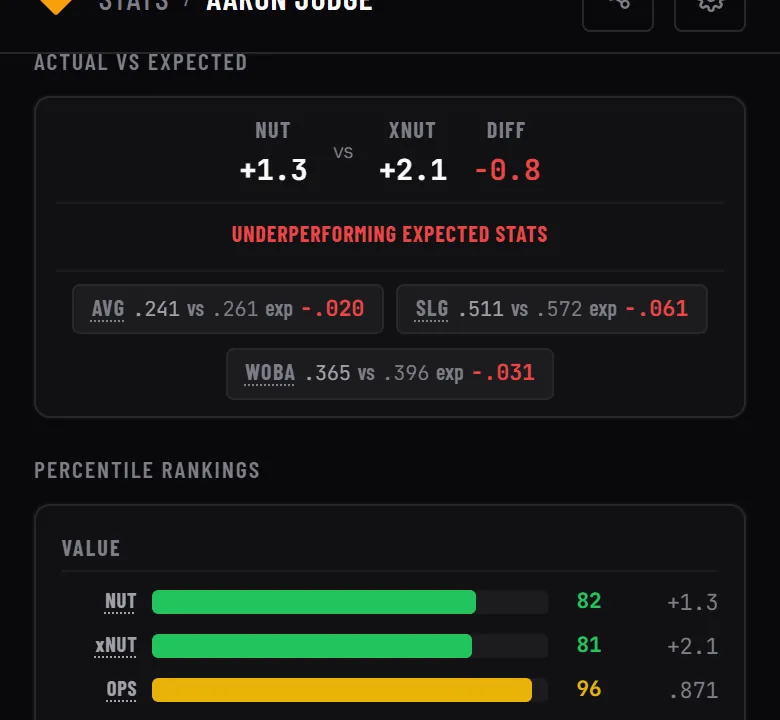
On every player profile in Baseball NUT, you will find an Expected vs Actual section on the Season tab. This is where we show each hitter's xBA, xSLG, and xwOBA alongside their actual numbers — with the gap highlighted so you can instantly see who is running hot, who is due for a correction, and who is earning every bit of their production.
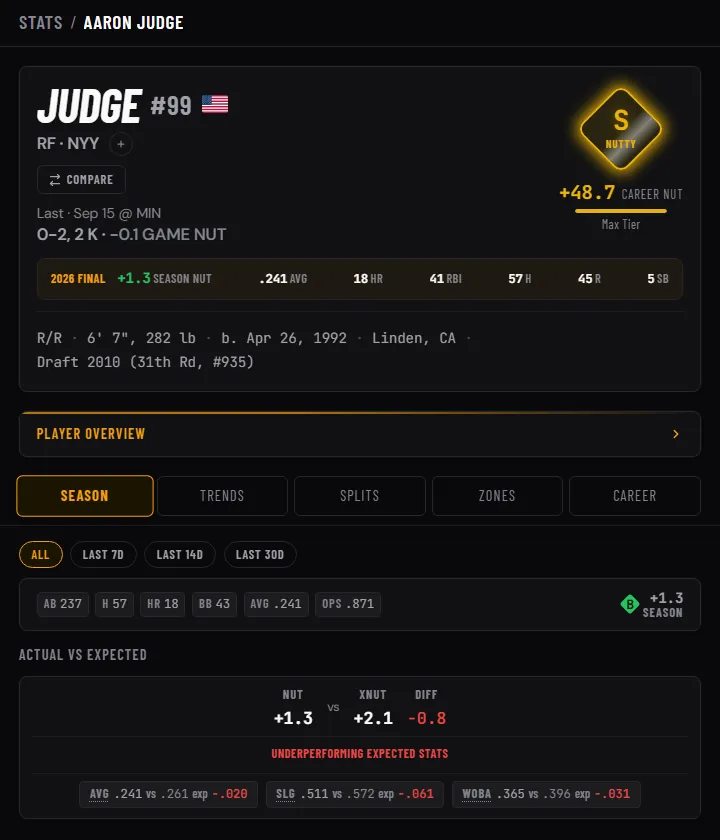
But we take it one step further with xNUT. Just like the regular NUT Score converts a hitter's wOBA into a production score, xNUT converts their xwOBA into that same production score. The difference between xNUT and NUT tells you how much of a player's current value is supported by contact quality versus how much might be noise.
A hitter with a NUT of +3.2 and an xNUT of +4.5 is being robbed — their contact quality says they should be performing even better than they are. A hitter with a NUT of +3.2 and an xNUT of +1.8 is riding a wave that the underlying numbers do not fully support.
The same framework works for pitchers. A pitcher's xNUT comes from xwOBA-against and total batters faced — it tells you whether their FIP-based NUT is earning the contact quality they are inducing, or getting away with weaker peripherals. Big gap, same signal: regression is likely, in one direction or the other.
You can find xNUT on each player's profile page and across the xNUT leaderboard on the Stats page — filterable by team, position, and league, with separate hitting and pitching views. It is one of the most useful tools in the app for identifying breakout candidates, regression risks, and fantasy baseball buy/sell targets.
How to Use Expected Stats in Practice
Here is a quick framework for applying expected stats to your baseball watching and your fantasy leagues:
- Buy low on hitters whose xwOBA far exceeds their wOBA. They are hitting the ball well but not getting the results their contact quality deserves. The market undervalues them because people look at the box score, not the contact quality.
- Sell high on hitters whose wOBA far exceeds their xwOBA. They are getting results they have not earned through contact quality. Some of this may be speed-related (which is sustainable), but for average-speed hitters, it is a clear sell signal.
- Evaluate slumps before panicking. If a star player is hitting .210 in April but their xBA is .275, they are fine. The hits will come. If their xBA is also .215, the slump is real — the quality of contact has dropped.
- Check the Glossary for benchmarks. Knowing that league-average xwOBA is around .315 gives you an anchor for evaluating any player you look at.
The Bottom Line
Expected stats answer a question that traditional stats cannot: is this player actually hitting the ball well, or are the results misleading? xBA tells you about the quality of contact. xSLG tells you about the quality of power. xwOBA wraps it all together into the single best measure of true offensive performance.
And with xNUT on Baseball NUT, you can see exactly how that expected performance translates into production — giving you the clearest possible picture of who is for real and who is running on borrowed time.