NUT vs WAR — One Number, Not Two
WAR (Wins Above Replacement) is baseball's most cited advanced stat. It tries to capture a player's total value in a single number. There's only one problem: there are two WARs.
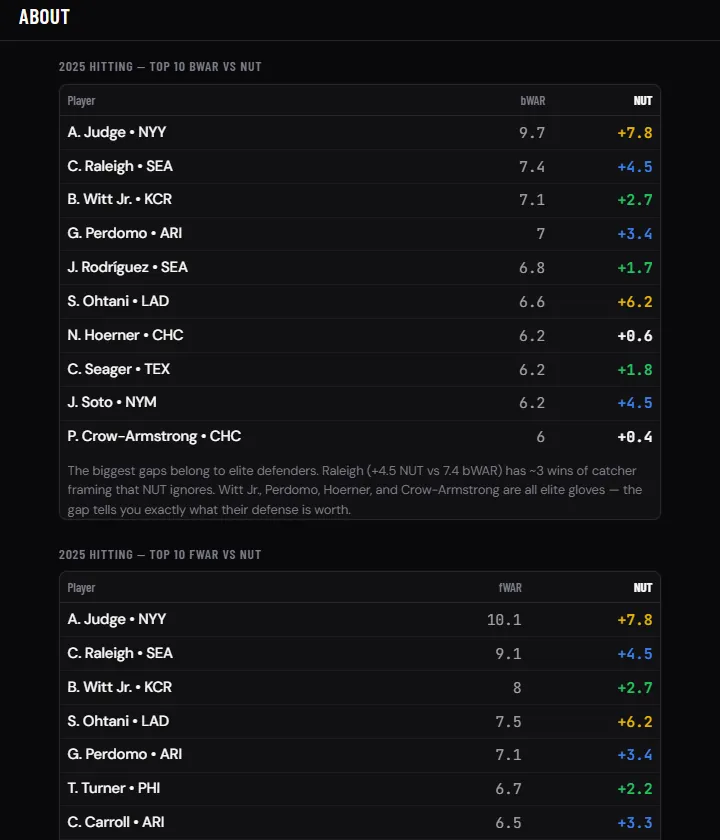
Baseball Reference's bWAR and FanGraphs' fWAR routinely disagree by 1-2 wins on the same player. Sometimes more. Whichever one you cite, someone will tell you to use the other. The two systems use different defensive metrics, different baselines, and different runs-to-wins conversions, and they don't agree on what a season was worth until well after the season is over.
NUT (Net Unbiased Total) takes a simpler approach. One number. Same everywhere. Built on the parts of the game we can actually measure precisely — hitting and pitching — without the defensive guesswork that drives most of the WAR disagreement.
NUT is the number the box score doesn't want you to see. The box score tells you what happened. NUT tells you what mattered.
Why bWAR and fWAR Disagree
Most of the gap between bWAR and fWAR comes from one place: defense. Baseball Reference uses Defensive Runs Saved. FanGraphs uses Ultimate Zone Rating. They're completely different systems, and they don't agree on what a fielder did, let alone what he was worth.
Defensive metrics are noisy. A player can rate as elite one year and average the next, with no real change in ability. Much of what they capture isn't even individual skill — it's positioning, shifts, and how a coaching staff lined the team up. The credit goes to the player; the decision came from the dugout.
NUT doesn't try to settle that argument. It leaves defense out. If two of the most respected sites in baseball can't agree on what a player's defense was worth, it shouldn't be in the number that's supposed to settle the argument.
Side-by-Side: How They Calculate Value
| Component | NUT | WAR |
|---|---|---|
| Hitting | wOBA-based | wOBA or OPS+ based |
| Pitching | FIP (K, BB, HR only) | FIP (fWAR) or RA9 (bWAR) |
| Defense | Not included | DRS (bWAR) or UZR (fWAR) |
| Baserunning | Not included | Included |
| Baseline | League average | Replacement level |
| Consistency | Same number everywhere | bWAR and fWAR disagree |
Real Example: When the Numbers Don't Agree
In 2025, Cal Raleigh had three different season values depending on who you asked. Baseball Reference said 7.4 wins. FanGraphs said 5.8 wins. NUT rated him at +4.5. Same player, same season, three answers. The 1.6-win gap between bWAR and fWAR is catcher framing — bWAR credits it, fWAR weights it differently. Add NUT's decision to leave defense out entirely and you get a 2.9-point spread on one season. That's a Cy Young away from a back-end starter, depending on which number you cite.
Cal Raleigh 2025 — Same Player, Three Different Numbers
The 2.9-win gap is mostly catcher framing — a defensive metric that bWAR and fWAR don't even agree on themselves.
Which number is "right"? That's the problem — there's no consensus, and there won't be. NUT skips the argument by measuring only what happened at the plate and on the mound. One number, calculated the same way every time.
When WAR Is the Right Tool
WAR isn't wrong — it's trying to answer a broader question. If you want a player's total contribution including defense, baserunning, and positional adjustment, WAR is the stat for that. For comparisons where defense matters (like a Gold Glove shortstop next to a DH), WAR captures more of the picture. Just pick a version and stick with it, and know that the other version may not agree.
When NUT Is the Right Tool
NUT is for the cases where you want a single answer that doesn't depend on which website you trust:
- Settling arguments — one number, same everywhere
- Reading box scores honestly — NUT shows what mattered, not just what got recorded
- Comparing hitters — apples-to-apples, no defensive adjustments to argue about
- Pitcher value — FIP-based, so the defense behind him doesn't inflate or deflate the number
- Fantasy baseball — NUT correlates cleanly with the production fantasy actually rewards
- Quick reads — positive = helping the team, negative = costing it. Triple-A callup territory below -1.0.