How to Read a Baseball Box Score — A Complete Beginner's Guide
If you've ever looked at a baseball box score and felt lost, you're not alone. Box scores are packed with abbreviations, numbers, and stats that can look like a foreign language if nobody ever explained them.
This guide breaks down every part of a baseball box score in plain English — from the line score at the top to the batting and pitching stats below. By the end, you'll be able to glance at any box score and understand exactly what happened in the game.
1. The Line Score — The Game at a Glance
The line score is the first thing you see. It shows how many runs each team scored in each inning, plus totals for runs (R), hits (H), and errors (E).
| 1 | 2 | 3 | 4 | 5 | 6 | 7 | 8 | 9 | R | H | E | |
|---|---|---|---|---|---|---|---|---|---|---|---|---|
| LAD | 2 | 0 | 2 | 1 | 1 | 3 | 4 | 1 | 0 | 14 | 17 | 0 |
| TOR | 1 | 0 | 0 | 0 | 0 | 0 | 0 | 0 | 1 | 2 | 5 | 2 |
Reading left to right: the Dodgers scored 2 runs in the 1st inning, 0 in the 2nd, 2 in the 3rd, and so on. The final columns tell you the totals: LAD had 14 runs on 17 hits with 0 errors. TOR had 2 runs on 5 hits with 2 errors.
H = Hits — total base hits (singles, doubles, triples, home runs).
E = Errors — defensive mistakes that allowed a batter to reach base or a runner to advance.
The visiting team is always on top, home team on the bottom. If the home team is winning after the top of the 9th, the bottom of the 9th isn't played — you'll see a dash or “X” in that column.
2. Batting Stats — How Each Hitter Performed
Below the line score, you'll see a table for each team's batters. Here's what each column means:
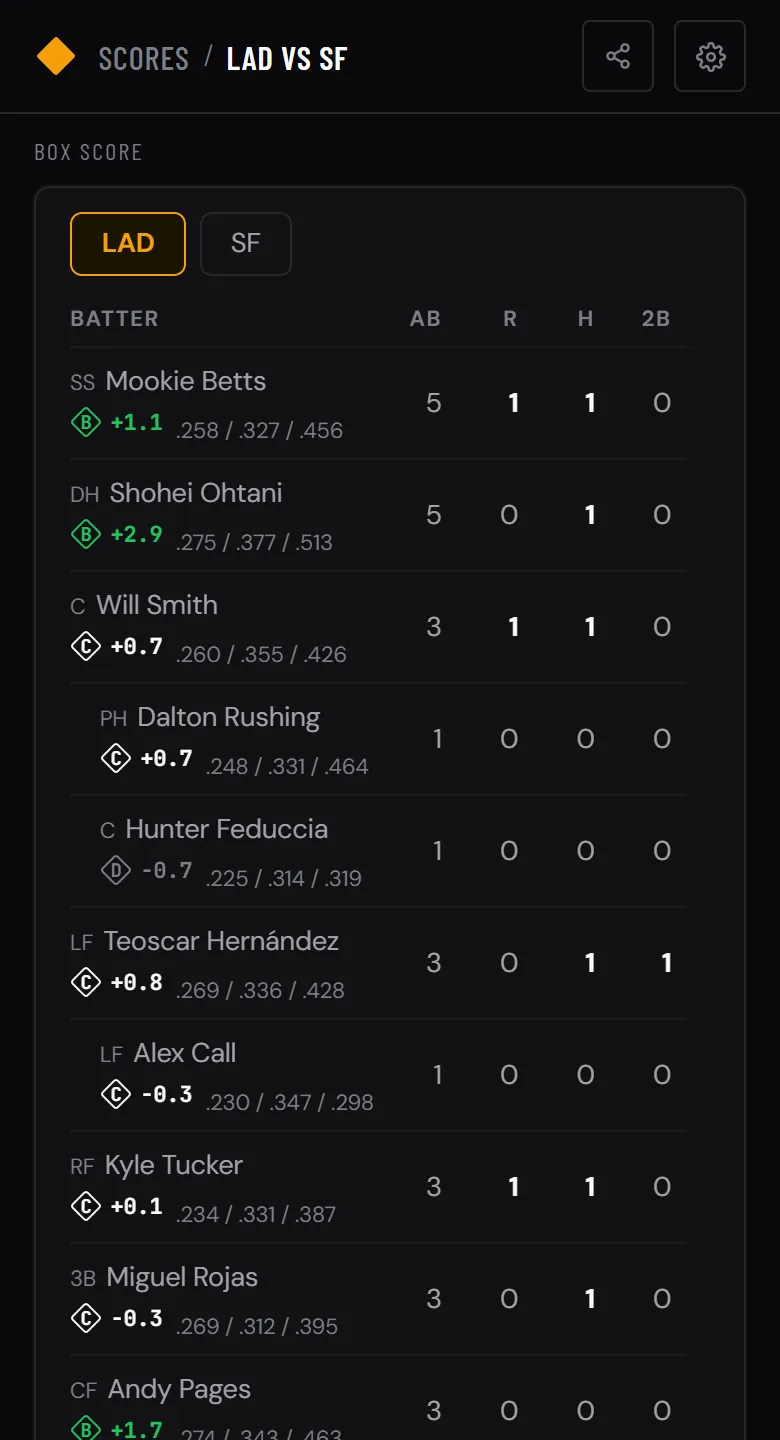
A typical batting line looks like this:
| Batter | AB | R | H | 2B | 3B | HR | RBI | BB | SO | AVG |
|---|---|---|---|---|---|---|---|---|---|---|
| D. Rushing | 4 | 2 | 4 | 1 | 0 | 2 | 2 | 0 | 0 | .381 |
| T. Hernández | 5 | 2 | 2 | 0 | 0 | 1 | 4 | 0 | 1 | .286 |
| F. Freeman | 4 | 2 | 2 | 1 | 0 | 1 | 3 | 1 | 0 | .300 |
Dalton Rushing went 4-for-4 (4 hits in 4 at-bats) with 2 home runs and 2 RBI. That's an elite game. Teoscar Hernández drove in 4 runs despite only getting 2 hits — meaning his hits came with runners on base.
3. Pitching Stats — How Each Pitcher Performed
The pitching section shows every pitcher who threw in the game:
| Pitcher | IP | H | R | ER | BB | SO | ERA |
|---|---|---|---|---|---|---|---|
| Y. Yamamoto (W) | 6.0 | 3 | 1 | 1 | 2 | 8 | 2.45 |
| B. Treinen | 1.0 | 0 | 0 | 0 | 0 | 2 | 1.80 |
| D. Hudson | 2.0 | 2 | 1 | 1 | 0 | 1 | 3.60 |
Yamamoto threw 6 innings, allowed 3 hits and 1 earned run, walked 2, and struck out 8. The “(W)” means he got the win. You'll also see “(L)” for the losing pitcher and “(S)” for a save.
ERA (Earned Run Average) tells you how many earned runs a pitcher allows per 9 innings. Lower is better. Under 3.00 is excellent, around 4.00 is league average. Learn more in our ERA deep dive.
4. Advanced Stats — Going Deeper
Modern box scores often include advanced stats beyond the basics. Here are the most common ones you'll see on Baseball NUT:
For Hitters
OBP measures how often a batter reaches base (including walks). SLG measures power (extra-base hits are worth more). OPS combines both into one quick number — .800+ is good, .900+ is excellent.
For Pitchers
WHIP tells you how many baserunners a pitcher allows per inning (under 1.10 is great). FIP is like ERA but only counts what the pitcher controls — strikeouts, walks, and home runs.
5. NUT Score — One Number for Player Value
On Baseball NUT, every player and every game gets a NUT Score. NUT measures how much production a player adds to their team using wOBA for hitters and FIP for pitchers.
On Baseball NUT, each team's NUT sits directly under its score on the game card — say LAD “+0.9” over SF “+0.6”. Add the two and you get the game's Total NUT (1.5 in that example). Higher NUT = more exciting, higher-quality game. The split shows which side carried the production.
It's the one number you need if you want to know who's actually producing value — not just who hit a home run or who got the win.
Quick Reference — Every Box Score Abbreviation
Bookmark this and come back whenever you need it:
For deeper explanations of any stat, check the full Baseball Stats Glossary.
Try It Yourself
The best way to learn is to look at a real box score. Open any game on Baseball NUT, tap into the game detail, and you'll see the full line score, box score, play-by-play, and NUT Score — all in one place, with no ads or clutter.