NUT Check — The Free Baseball Trivia Game That Tests Your MLB Knowledge
Think you know baseball? NUT Check is a free baseball trivia game that puts your knowledge of MLB career stats to the test. Two choices appear side by side and you pick the one with the higher NUT. The daily puzzle is 10 rounds, and Free Play covers 13 decades of baseball history, from the 1900s to today.
How NUT Check Works
Every round shows two choices: two MLB players from the same pool (hitters vs hitters, pitchers vs pitchers). You tap the one with the higher NUT, Baseball NUT's production score.
After each pick, both numbers count up on screen, then both careers appear side by side, so you see exactly why one beat the other.
Daily NUT Check: One Puzzle a Day
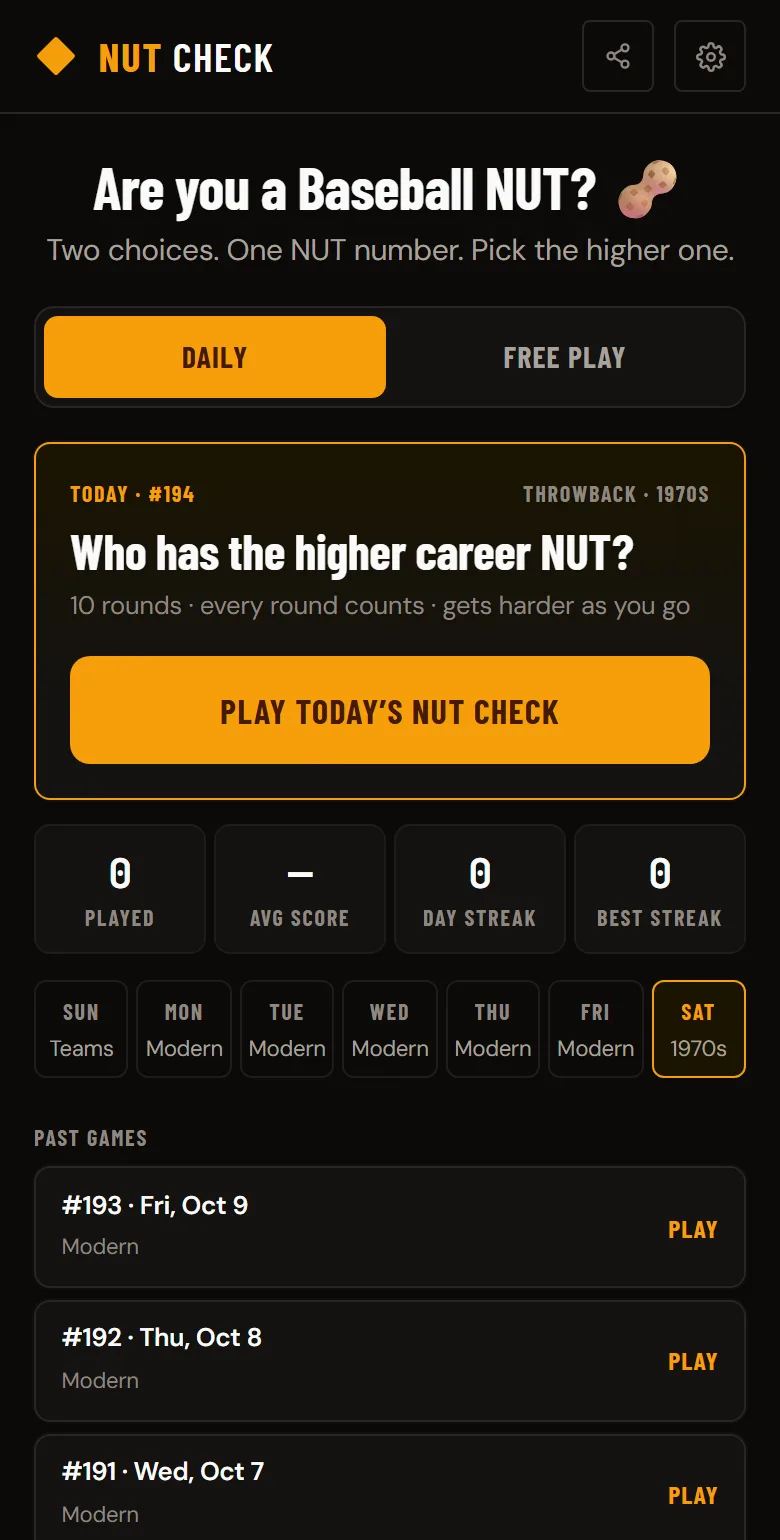
The daily puzzle is 10 rounds, and every round counts: your score is how many you get right. Everyone gets the same 10 matchups on the same day, and the theme rotates by weekday:
- Monday–Friday, Modern: 2000s–2020s players, career NUT
- Saturday, Throwback: one older decade, 1900s through 1990s, rotating each week
- Sunday, All-time: players from every decade, 1900s to 2020s
Share your result as a grid of green and red squares, one per round:
🟩🟩🟩🟥🟩🟩🟩🟥🟩🟩
Throwback · 1970s · All-Star
baseballnut.app/nut-check
The results screen tracks games played, your average score, your day streakand best streak, and how your scores spread from 0 to 10. Missed a day? The last 7 daily puzzles stay playable (they don't count toward your day streak).
Free Play: How Long Can You Last?
Free Play is sudden death: one miss ends the run. Pick any of 13 decades, from the 2020s back to the 1900s. Every round asks NUT, and the gaps shrink the longer your run lasts.
It Gets Harder as You Go
Each round has a difficulty level, set by how far apart the two numbers are:
- Rookie (rounds 1–3): clear gaps, 8 to 20 career NUT apart for hitters
- Veteran (rounds 4–6): 4 to 12 apart
- All-Star (rounds 7–9): 1.5 to 7 apart
- Hall of Fame (round 10): 3 or less, near coin flips
Pitcher rounds use tighter bands, because their NUT runs on a smaller scale.
13 Decades of Baseball History
NUT Check features over 1,000 MLB players spanning every era of professional baseball:
- 2020s: Ohtani, Judge, Soto, Skubal, deGrom
- 2010s: Trout, Kershaw, Scherzer, Harper, Cabrera
- 2000s: Pujols, Bonds, A-Rod, Halladay, Santana
- 1990s: Griffey Jr., Maddux, Pedro, Thomas, Piazza
- 1980s: Rickey Henderson, Schmidt, Clemens, Boggs, Ryan
- 1970s: Aaron, Bench, Seaver, Carlton, Rose
- 1960s: Mays, Koufax, Mantle, Gibson, Frank Robinson
- 1950s: Williams, Spahn, Banks, Snider, Berra
- 1940s: DiMaggio, Musial, Feller, Kiner
- 1930s: Ruth, Gehrig, Foxx, Grove, Ott
- 1920s: Cobb, Hornsby, Speaker, Walter Johnson
- 1910s: Wagner, Mathewson, Eddie Collins
- 1900s: Cy Young, Lajoie, Mordecai Brown, Ed Walsh
All stats are full career totals— the decade just determines which players you see. So you're always comparing complete careers, not just what someone did in a single era.
How NUT Check Helps You Learn Baseball
Most baseball trivia games test whether you can remember random facts. NUT Check is different — it builds your intuition for player value. After a few games, you start developing a feel for what a “good” career batting average looks like, how many home runs separates a great player from an all-time great, or what ERA range puts a pitcher in the Hall of Fame conversation.
Every wrong answer teaches you something. When you guess that Derek Jeter had more career home runs than Chipper Jones and find out you were wrong (260 vs 468), that sticks with you. It's learning through playing, not studying.
The 13-decade span also gives you exposure to players you might not know well. Most fans know the modern stars, but how much do you know about 1950s pitchers or 1930s sluggers? NUT Check fills in those gaps naturally.
Share and Compete
NUT Check is built for sharing. After every game, you can:
- Share — opens your phone's share sheet, or copies the grid on a computer
- Post on X — opens X with your grid and score filled in
Since the daily game is the same for everyone, comparing scores is meaningful. Your 8/10 vs your friend's 6/10 means you genuinely knew those matchups better.
What Is the NUT Score?
Every daily round asks the NUT Score— Baseball NUT's signature metric. NUT (Net Unbiased Total) measures how much production a player adds to their team using only hitting and pitching data. No unreliable defensive metrics, no opinion — just the numbers.
Picking the higher NUT means picking the player that produced more. That is the question NUT Check asks every day.
Why We Built NUT Check
Baseball has the richest statistical history of any sport. Over a century of data, thousands of players, every at-bat and every pitch recorded. But most fans only know a fraction of it. We wanted to build something that makes exploring that history fun — not a textbook, not a quiz show, but a game you actually want to play every day.
NUT Check is that game. It takes 2 minutes to play, you learn something every round, and the daily challenge gives you a reason to come back tomorrow. Whether you're a lifelong baseball fan or just getting into the sport, it meets you where you are — the early rounds are forgiving, and it only gets hard if you're doing well.
Play NUT Check — Free, No Account Required
NUT Check is completely free. No account needed, no ads, no paywalls. Just open it and play. It works on any device — phone, tablet, or desktop.
Frequently Asked Questions
Is NUT Check free?
Yes. NUT Check is completely free to play with no account required. There are no ads and no paywalls.
How often does the daily game change?
A new Daily NUT Check is available every day at midnight. Each day features a randomly selected decade and stat category with 10 rounds of matchups.
Can I play old daily games?
Yes. NUT Check keeps a 7-day archive of past daily games. You can go back and play any game from the last week. Archive games don't count toward your day streak.
What decades are available?
NUT Check covers 13 decades: 1900s, 1910s, 1920s, 1930s, 1940s, 1950s, 1960s, 1970s, 1980s, 1990s, 2000s, 2010s, and 2020s. Most decades have 50 hitters and 50 pitchers; the 1900s pool is slightly smaller at 45 each.
Are the stats accurate?
Yes. All career stats are pulled directly from the MLB Stats API. NUT values are calculated using the same methodology used across all of Baseball NUT.
How is NUT Check different from other baseball trivia games?
Most baseball trivia games ask you to recall random facts. NUT Check tests your feel for player value — you need to know roughly where players fall in each stat category. It's less about memorization and more about baseball intuition. The difficulty scaling also means the game adapts to your skill level.